



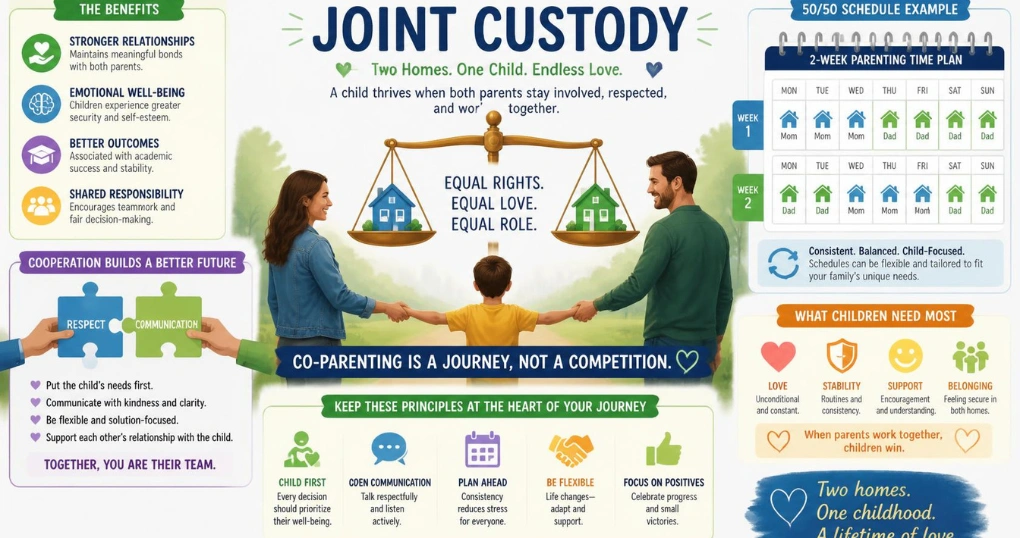
Joint custody generally means that separated or divorced parents share important responsibilities for raising their child. Those responsibilities may involve major decisions, parenting time, or both, depending on the court order and the law of the state involved. It does not automatically require parents to divide every decision or every overnight equally. Also worth reading: How to File for Divorce in the U.S.
| Key question | General U.S. answer |
| What does shared custody cover? | Legal decision-making, physical care, or both |
| Does it always mean 50/50 time? | No |
| Can one parent have more parenting time? | Yes. |
| Can child support still be ordered? | Yes. |
| What standard do courts use? | The child’s best interests |
| Are the rules identical nationwide? | No, custody law varies by state. |
Direct answer: Shared custody can involve joint legal decision-making, substantial parenting time with both parents, or a combination of the two. A child does not necessarily spend half of every week with each parent. Courts and parents generally structure custody around the child’s needs, state law, safety concerns, school, and practical family circumstances.
Key Takeaways
- Legal custody concerns major decisions about matters such as education and health care.
- Physical custody concerns where the child lives and how parenting time is divided.
- Equal parenting time is one possible arrangement, not a universal requirement.
- Child support can still apply even when both parents share custody.
- State rules and terminology differ, so local law matters.
- A detailed parenting plan can reduce future confusion about schedules and decisions.
How Joint Custody Works Under U.S. Law

Child custody usually has two separate parts: legal custody and physical custody. Parents can share one part while another part is structured differently. Joint custody: For example, both parents may participate in major decisions even when the child spends more nights in one home.
There is no single nationwide custody formula that every family court follows. State statutes, court rules, and terminology can differ, even though the child’s best interests are central to custody decisions across jurisdictions. For broader educational material about how legal terminology can vary, readers can also browse Veriibe’s Law section.
Legal Custody vs. Physical Custody
| Type | What it generally controls | Does it require equal time? |
| Joint legal custody | Major decisions about education, health care, religion, and similar issues | No |
| Joint physical custody | The child’s physical care and time in each parent’s home | No |
| Sole legal custody | One parent has primary authority for major decisions. | Not applicable |
| Sole or primary physical custody | The child primarily resides with one parent. | No |
Legal custody focuses on authority rather than the number of nights a child spends with each parent. Courts may require parents with shared legal authority to consult one another about major choices, while routine daily decisions are normally handled by the parent caring for the child at that time. The exact division of authority depends on the custody order and state law.
Physical custody concerns the child’s residence and day-to-day care. A shared physical arrangement can involve substantial time in both homes without producing an exact fifty-fifty split. Cornell’s Legal Information Institute, in a Wex entry on joint custody last reviewed in July 2025, describes joint custody as shared decision-making authority, shared physical care, or both.
Does Shared Custody Always Mean a 50/50 Schedule?
A fifty-fifty schedule is one option, but the term itself does not promise an equal division of parenting time. Courts can approve schedules that give both parents meaningful time while still placing more school nights or overnights with one parent. The child’s age, school schedule, distance between homes, parental availability, and other practical concerns may affect the arrangement.
State definitions can also make broad national claims misleading. Utah, for example, uses a specific overnight threshold in its definition of shared physical custody, while other jurisdictions use different wording or standards. Parents should therefore read the actual order instead of assuming the phrase alone explains their schedule.
Common Parenting-Time Schedules
Families can organize shared parenting time in several ways, and no schedule fits every child. Younger children may benefit from a different routine than teenagers, while school distance can make frequent exchanges difficult. Parents should focus on predictability, transportation, school obligations, and the child’s individual needs.
Examples of schedules parents may encounter include:
- Week-on, week-off: The child stays approximately one week with each parent before switching homes.
- 2-2-3 rotation: One parent has two days, the other has two days, and the remaining three days alternate between parents.
- 2-2-5-5 rotation: Each parent receives consistent weekdays along with alternating longer periods.
- Primary-home schedule: The child has one primary residence while spending regular weekends, holidays, vacations, or other substantial periods with the other parent.
- Customized school-year plan: Parenting time changes between the school year, summer vacation, and major holidays.
A New Jersey appellate decision, for example, describes a 2-2-3 arrangement used by parents who shared parenting time equally. That example shows what one schedule can look like, but it does not create a nationwide rule or a recommendation for every family. The best schedule is the one that complies with the applicable order and works safely for the child’s circumstances.
How Courts Decide Custody Arrangements
Courts generally focus on the child’s best interests rather than simply rewarding one parent’s preferred schedule. Relevant considerations can include the child’s needs, each parent’s ability to meet those needs, stability, family relationships, and safety concerns. The precise statutory factors differ from state to state.
A parent’s request for equal time does not automatically determine the outcome. Judges may examine communication between the parents, transportation, school arrangements, existing caregiving patterns, geographic distance, and other facts permitted under state law. If parents reach an agreement, a court may still review the proposed arrangement before incorporating it into an enforceable order.
Safety can materially change the analysis. Abuse, neglect, domestic violence, threats, or other risks may affect whether shared decision-making or unsupervised parenting time is appropriate under a state’s laws. Because state terminology can differ substantially in legal matters, Veriibe’s assault and battery explainer offers another example of why readers should check the law that applies in their jurisdiction rather than relying on labels alone.
What Should a Parenting Plan Cover?
A detailed parenting plan can make a shared arrangement easier to follow because it converts broad custody terms into practical rules. Maryland Courts, for example, requires parenting plans in cases involving custody of a minor child and provides tools addressing parental responsibilities. Requirements differ elsewhere, but written details can help parents understand exactly what is expected.
A useful plan may address several practical areas.
- Regular weekday and weekend schedules.
- School breaks, holidays, birthdays, and vacations.
- Pickup, drop-off, and transportation responsibilities.
- Education and school-enrollment decisions.
- Medical, dental, and mental health decisions.
- Extracurricular activities.
- Parent-to-parent communication.
- Access to school and medical information.
- Travel and relocation procedures.
- Child-related expenses.
- Methods for resolving future disagreements.
- Emergency and safety procedures.
Parents sometimes describe a parenting plan as an agreement, but its legal effect depends on the circumstances and court process. A private understanding should not be assumed to have the same effect as an entered custody order. Readers reviewing general agreement terminology can also see Veriibe’s contracts explainer, while custody-specific questions should be checked against state family law.
Can Child Support Apply When Parents Share Custody?
Sharing parenting time does not automatically eliminate child support. The North Carolina Judicial Branch expressly explains that a parent may still be required to pay support when the parents have a joint arrangement. Other states use their own support guidelines, formulas, income rules, and parenting-time adjustments.
That means a fifty-fifty parenting schedule does not necessarily produce a zero-dollar support order. Income differences, health insurance obligations, childcare costs, the number of overnights, and other state-specific factors may affect the calculation. Parents should use the official calculator, worksheet, or court guidance for the state handling their case rather than relying on a national estimate.
Shared Legal Custody With One Primary Home
Parents do not have to share physical care equally to share major decision-making. A child may live primarily with one parent while both parents retain authority over education, non-emergency health care, and other important matters. Courts in several jurisdictions expressly recognize combinations of shared legal authority and unequal physical parenting time.
This distinction matters because the words on a custody order can affect different rights. Knowing that one parent is the primary residential parent does not, by itself, tell you whether that parent has sole authority over major decisions. The legal-custody provisions and parenting-time provisions should be read separately.
When Shared Parenting May Be Difficult
Shared arrangements require more than dividing dates on a calendar. They can become harder to manage when parents live far apart, cannot communicate safely, repeatedly ignore the schedule, or disagree about major decisions without an effective resolution process. A child’s educational, medical, developmental, or emotional needs may also require a more specialized arrangement.
Safety deserves separate attention from ordinary co-parenting disagreements. Domestic violence, abuse, neglect, stalking, substance-related risks, or credible threats can change the options available under state law.
What Parents Should Do Next
Start with the custody order if one already exists because its specific language controls the responsibilities assigned in that case. If no order exists, check the official family-court or judicial-branch resources for the state with jurisdiction before relying on a generic schedule or form. A family-law attorney licensed in that state can explain how local statutes, court rules, and facts apply to an individual situation.
Joint custody Parents who can communicate safely may also benefit from writing down proposed schedules, exchange procedures, holiday arrangements, and decision-making responsibilities before mediation or court. Doing that can expose practical conflicts before they become disputes about missed exchanges or major decisions. The goal should be a workable plan centered on the child’s safety, stability, and daily needs
Frequently Asked Questions
Does joint custody mean parents get exactly 50/50 time?
No. Shared physical care can involve equal time, but equal parenting time is not automatically required by the term. The schedule depends on state law, the custody order, and the circumstances of the child and parents.
Can parents share legal custody if the child mainly lives with one parent?
Yes, that combination is possible in many jurisdictions. The parents can share authority over major decisions while one home remains the child’s primary residence. The wording of the court order determines how those responsibilities are divided.
Can a parent still pay child support with shared parenting time?
Yes. Shared physical care does not automatically cancel either parent’s financial support obligations. State formulas may consider income, parenting time, childcare, insurance, and other permitted expenses.
What happens if parents cannot agree on major decisions?
The answer depends on the custody order and state law. Some orders explain how specific disputes must be handled, while unresolved conflicts can sometimes require mediation, a court filing, or another authorized procedure. Parents should review the decision-making provisions of their own order before assuming either parent has final authority.
Is shared custody always the preferred arrangement?
No arrangement is appropriate in every case. Courts focus on the child’s best interests and may consider safety, stability, parental capabilities, relationships, and other factors defined by state law. Abuse or domestic violence can materially affect whether shared authority or parenting time is appropriate.
